
Slice of Life: Energy and Life Management Prioritization
Ever start Monday with a flawless, color-coded 47 item to-do list, only to end Friday burnt out on the couch, staring at the ceiling, wondering where it all went wrong?
If you struggle with executive dysfunction, ADHD, or chronic overwhelm, this cycle isn't a failure of willpower. It’s a classic symptom of altered time perception, or the cognitive quirk that makes us believe we have an infinite amount of time and energy to give to everything, all at once. As challenging as it is to hear, our time and energy are both incredibly finite resources.
We treat our lives like an all-you-can-eat buffet. We pile our plates high with career goals, intensive self-care routines, a spotless house, and active social lives, completely forgetting that our internal "plate" has a physical limit.
If we want to stop burning out, we need to stop thinking about our capacity as an all you can eat buffet and start looking at it for what it actually is: a finite pie, or pie chart.
The "Slice of Life" Framework
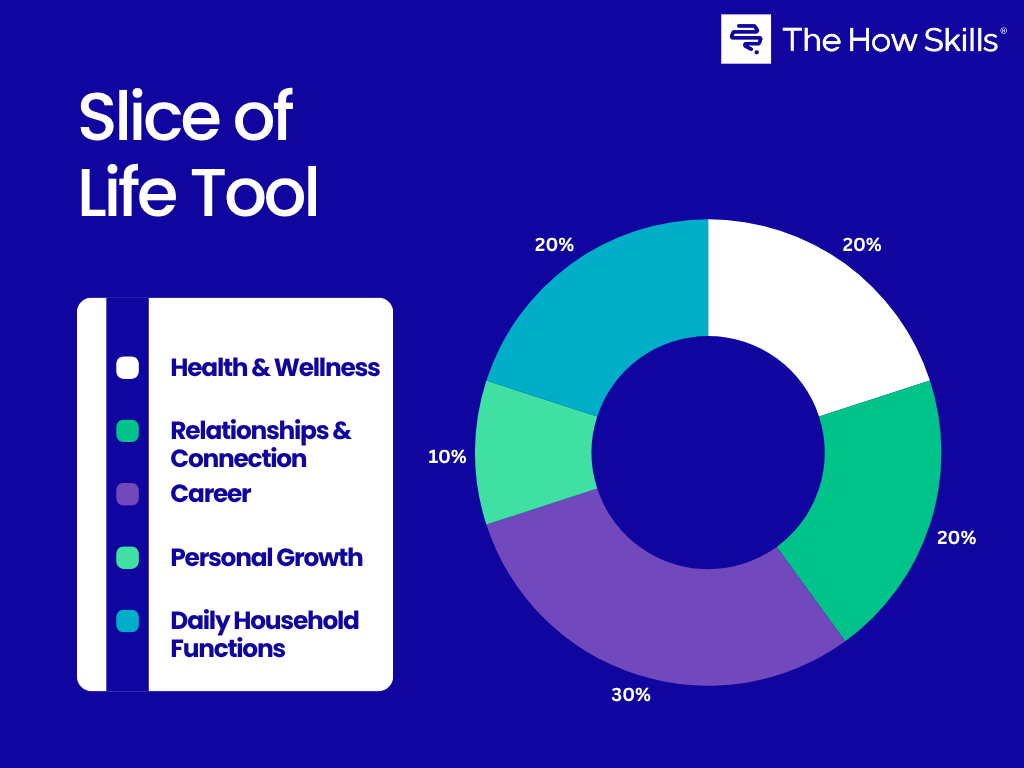
To manage executive function barriers, some individuals prefer visual representations of their week using either a calendar, graph, or to-do list. For this framework, we’ll be using a pie chart. This pie chart represents 100% of your week: you do not get any extra time or energy, even if you want it. If one slice of your life gets bigger, another slice must get smaller. You cannot simply expand the pie.
Every week, your cognitive budget is exactly 100%. Here are the 5 core buckets that compete for a piece of that pie:
Health & Wellness: Sleep, meals, movement, medication, therapy, and basic sensory decompression.
Relationships & Connection: Quality time with a partner, texting a friend back, or attending social gatherings.
Career: Deep work, meetings, admin tasks, and professional development.
Personal Growth: Hobbies, reading, guilt-free unstructured creative time, or learning something new just for fun.
Daily Household Functions: The "boring but crucial" stuff—laundry, groceries, mail, dishes, and bills.
How to Budget Your Bandwidth (Without the Guilt)
When you sit down to plan your week, don't just write a list of tasks. Allocate your percentages first.
If you have a massive project due at work, your Career slice might jump to 50%. That is mathematically fine, but it means your other buckets must split the remaining 50%. You might have to drop Daily Household Functions to 10% (this might mean less time prepping dinner, and more time with paper plates and takeout) and Relationships to 10% (this might mean canceling dinner plans and sending a quick text to friends saying, "In a cave this week, talk soon!").
The magic of this tool isn't that it magically gets more done; it's that it removes the guilt of what isn't getting done. You aren't failing at housekeeping; you just consciously chose to shrink that slice this week.
3 Reality Checks for the Overwhelmed Brain
Before you lock in your weekly pie chart, run it through these executive function filters:
1. Pay the "Underestimation Tax"
Our brains are notoriously bad at guessing how long tasks take. We think cleaning the bathroom takes 10 minutes, forgetting the 20 minutes of transition energy it takes to find the supplies, get distracted by a podcast, and actually start. Look at your Daily Household Functions bucket. If you budgeted 5%, bump it to 15% right now and take that energy away from somewhere else. Give yourself a buffer.
2. Embrace the "B+" Slice
Perfectionism is the enemy of “good enough”. For your biggest slice of the week, ask yourself: What does a B+ job look like here? Define what "good enough" actually means so your brain knows exactly where the finish line is.
3. Identify Your Non-Negotiable Crumb
Even if a bucket only gets 5% of your pie this week, what is the one micro-action that keeps it alive? If Health & Wellness is minimal because life is chaotic, your non-negotiable crumb might just be drinking a full glass of water before your coffee, or putting your phone away 15 minutes before bed. It doesn't have to be a 2-hour gym session to count.
Be Kind to the Pie
You are a human being with a finite nervous system, we are not machines who plug in each night and recharge to 100%. By visually budgeting your energy instead of continuously stacking your to-do list, you give your executive functioning skills the structure they need to thrive.
Look at your upcoming week: what slice needs the most room, and what are you going to intentionally shrink to make space for it?
