
Navigating the Double Disruption: Talent Retention Through Executive Function Coaching as a Support for Postpartum Mothers with ADHD Reentering the Workforce
Author’s Note: This research idea was presented at the 2026 Neurodiversity at Work Research Conference hosted in Seattle, Washington. It is not a complete study, it is intended to be a research idea in progress.
The Context of Disruption
In the current “Age of Disruption,” characterized by volatile labor markets and a systemic lack of parental support, the reentry of mothers into the workforce has become a primary source of professional friction. While this transition is challenging for all, it creates an even greater barrier for neurodivergent individuals, specifically those with Attention Deficit Hyperactivity Disorder (ADHD). For newly postpartum mothers with ADHD, the return to work is not merely a logistical hurdle but rather a “perfect cognitive storm,” as it is a collision of biological disruption, intensified executive function, or EF, deficits, coupled with the rigid expectations of modern work environments. This significant gap exists at the intersection of gender, neurodiversity, and life transitions and is best classified as: the reentry of newly postpartum mothers with ADHD back into the workforce. For the purpose of this research proposal, mothers with ADHD who have reentered the workforce within 1 year of giving birth will be examined.
The Problem: A Gap in Systemic Resilience
Current organizational frameworks often overlook the intersectionality of these identities, resulting in "one-size-fits-all" reentry policies that fail to account for the specific executive function challenges of areas like task initiation, emotional regulation, organization, memory, and time management, all of which are exacerbated during the postpartum period. Many mothers who rejoin the workforce after little to no parental bonding leave are faced with a mental health barrier as 66% of mothers report that they are "not mentally healthy" or are struggling with their mental well-being due to the "double duty" of work and caregiving (Motherly, 2023). In addition, 81% of working mothers are feeling “burnt out” (Motherly, 2024). This systemic gap coupled with increased demands at home without support, leads to the premature attrition of high-potential neurodivergent talent, weakening organizational diversity and resilience at a time when they are most needed. While many organizations claim "neuroinclusivity," their frameworks often rely on static accommodations rather than dynamic, evidence-based interventions like executive function coaching. Without targeted, customized, 1:1 support like executive function coaching with specific strategies, this demographic faces a high risk of burnout and departure from the workforce. This represents not only an individual struggle but a systemic failure to sustain neurodivergent talent during periods of profound personal and professional uncertainty: double disruption.
The Research Gap
There is a dearth of rigorous research examining how individualized EF coaching as an accommodation can be integrated into organizational policy to support individuals. This research argues that resilient solutions are not built for neurodivergent individuals, but with them. By utilizing differentiated executive function coaching as a co-designed, participatory intervention, organizations can improve overall support, output, and success of the company as a whole, and also of the individual. This study seeks to address how EF coaching serves as a critical resilience infrastructure, allowing postpartum ADHD employees to navigate shifting workplace demands while defending the legitimacy of neuroinclusive practices through proven, durable impact and a return on investment for retention of neurodivergent employees. The retention of postpartum, neurodivergent talent should become a critical barometer for organizational resilience.
Proposed Research Questions:
How does the "double disruption" of postpartum biological changes and ADHD neurodivergence create a unique set of executive function barriers that are not addressed by standard reentry policies?
To what extent does the model of Executive Function (EF) coaching as an accommodation allow postpartum ADHD mothers to shape their own "resilience infrastructure" rather than merely adhering to top-down, static accommodations?
How can the qualitative successes of individualized 1:1 EF coaching as an accommodation be translated into scalable, evidence-based organizational insights that provide a measurable return on investment (ROI) for talent retention for the company?
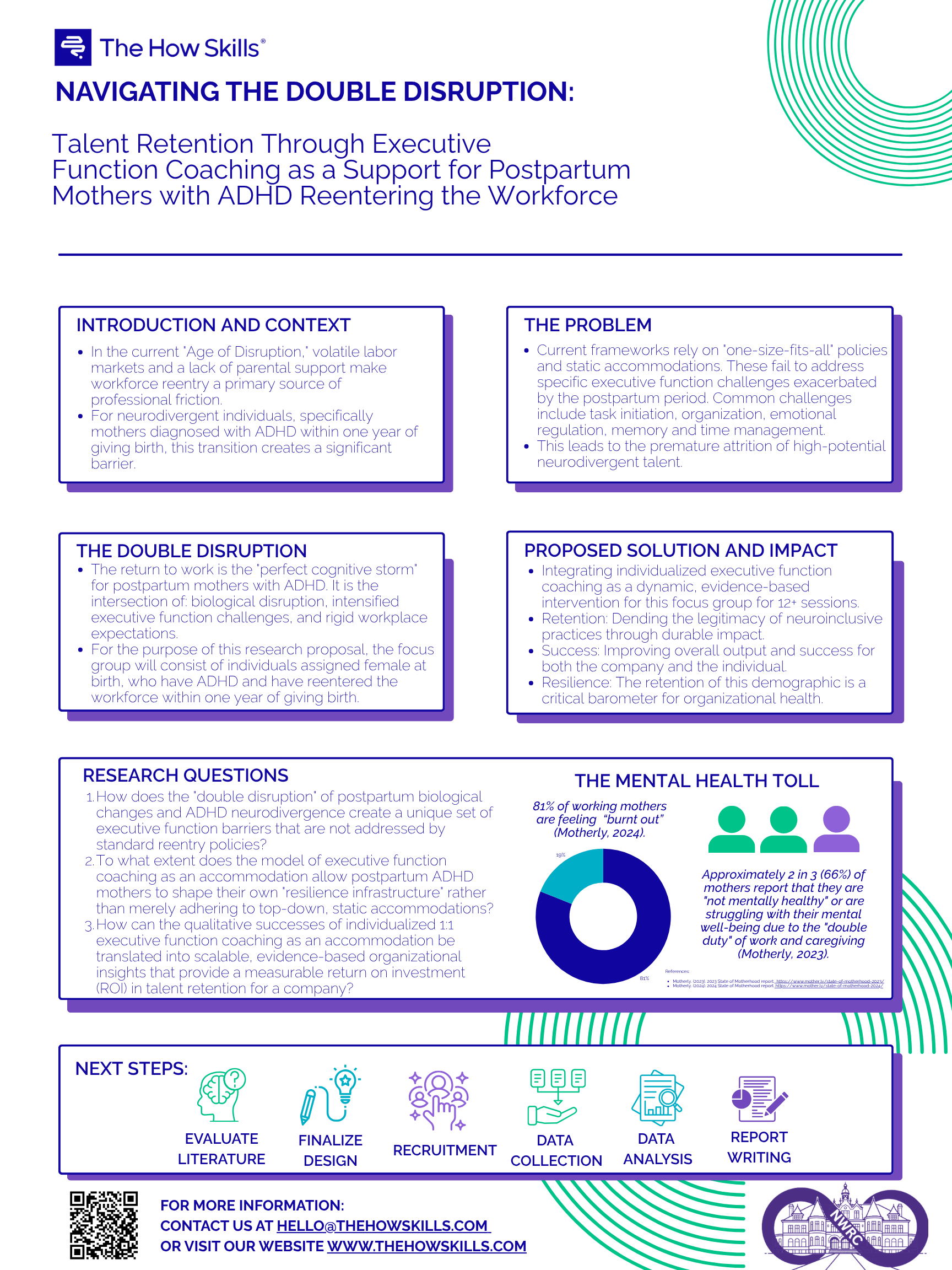
Image Description: An overview of the research process including context, next steps, and proposed solution.
References:
Motherly. (2023). 2023 State of Motherhood report. https://www.mother.ly/state-of-motherhood-2023/
Motherly. (2024). 2024 State of Motherhood report. https://www.mother.ly/state-of-motherhood-2024/
Authors: Jamie Ahrens Nadjari, Ed.D; Paige Porter, MiT
